
For many people, the word sustainability immediately brings to mind climate change, renewable energy, recycling, carbon emissions and protecting the environment.
These are important.
But sustainability is much bigger than the environment.
Sustainability is also about people.
It is about whether individuals can build meaningful livelihoods, whether businesses can remain productive and competitive, whether young people can develop relevant skills, whether employees can grow, and whether economies can create opportunities that last.
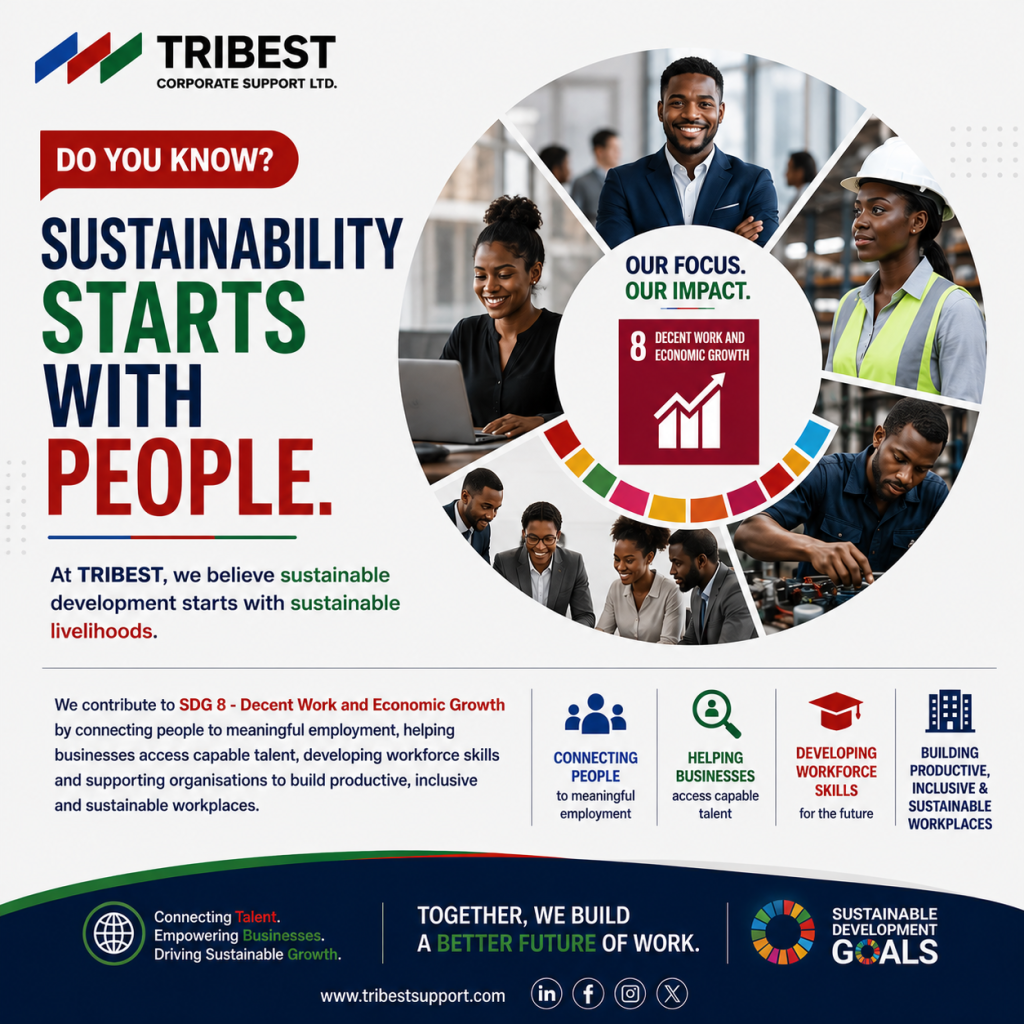
This is where TRIBEST believes it has a meaningful role to play in the Sustainable Development Goals (SDGs).
Sustainability Isn’t Only About Saving the Planet
- A business cannot be truly sustainable if it is environmentally responsible but cannot develop the people it depends on.
- An economy cannot thrive sustainably when large numbers of people are unable to access decent work.
- A company cannot sustain growth if it continuously loses capable employees because it has no strategy for development, engagement or retention.
- And a young person cannot fully participate in economic growth if they have education but lack the skills, experience or opportunities required to enter the workplace.
These are not simply HR problems.
They are sustainable-development problems.
The Sustainable Development Goals recognize the importance of decent work, inclusive economic growth, quality education, gender equality, reduced inequalities and partnerships.
For TRIBEST, this creates an opportunity to look at sustainability through a different but equally important lens:
People. Productivity. Opportunity.
What Happens When People Cannot Find Decent Work?
Employment is more than receiving a monthly salary. For many people, decent work represents independence, dignity, confidence, stability and the ability to contribute to their families and communities. When people cannot access meaningful employment, the consequences extend beyond the individual.
- Families may struggle.
- Skills may remain unused.
- Businesses lose potential talent.
- Communities lose productive capacity.
And the economy loses opportunities for growth.
This is why SDG 8 – Decent Work and Economic Growth is particularly relevant to TRIBEST.
TRIBEST’s work in recruitment, workforce solutions, training and development, outsourcing and related HR services places the organisation within an ecosystem that connects people with opportunities and businesses with talent.
The goal should not simply be to fill vacancies.
It should be to create better connections between talent and opportunity.
What Happens When Businesses Cannot Find the Skills They Need?
There is another side to the employment conversation.
While millions of people are looking for opportunities, many businesses continue to struggle to find people with the capabilities they need.
This creates a paradox:
People are looking for jobs, while businesses are looking for talent.
How can both be true?
The answer often lies in the gap between available talent and required skills.
Employers may need people who can communicate effectively, analyse information, use technology, solve problems, manage customers, work collaboratively and adapt to change.
A candidate may have a degree but lack some of these practical capabilities.
This is why workforce development matters.
Sustainable employment cannot be built only by creating vacancies.
We also need to develop people who are prepared to succeed in those vacancies.
That connects TRIBEST’s sustainability perspective with SDG 4 – Quality Education, particularly the importance of relevant skills for employment, decent work and entrepreneurship.
EDUCATION opens the door.
SKILLS help people walk through it.
What Happens When Young People Are Educated but Not Employable?
One of the biggest questions facing the future workforce is not simply:
“How many people are educated?”
It is:
“How prepared are people for the world of work?”
The workplace is changing.
Technology is changing.
Artificial intelligence is changing how tasks are performed.
Customer expectations are changing.
Business models are changing.
Consequently, the skills required by employers are also evolving.
Young people entering the workforce therefore need more than academic qualifications.
They need opportunities to develop:
- Digital skills
- Communication
- Problem-solving
- Critical thinking
- Emotional intelligence
- Adaptability
- Teamwork
- Leadership
- Industry-specific capabilities
For businesses, this means investing in workforce development.
For individuals, it means embracing continuous learning.
For organisations like TRIBEST, it means helping to strengthen the bridge between talent, skills and opportunity.
What Happens When Women Don’t Have Equal Access to Economic Opportunity?
Sustainability also requires inclusion.
If talented people are excluded from economic opportunities because of gender or other barriers, society loses potential.
Businesses lose talent.
Families lose economic opportunities.
And economies lose productive capacity.
For TRIBEST, supporting equal opportunity means encouraging fair access to employment, professional development and career advancement.
It also means asking difficult questions:
- Are recruitment processes genuinely inclusive?
- Are women being given opportunities to progress into leadership?
- Are organisations creating workplaces where different talents can thrive?
These conversations connect workforce development with SDG 5 – Gender Equality and SDG 10 – Reduced Inequalities.
Sustainability should not be about creating opportunities for only a few.
It should be about building systems in which more people can participate and contribute.
What Happens When Companies Constantly Lose Trained Employees?
Now consider the employer’s perspective.
A company recruits an employee.
It invests time and money in onboarding and training.
The employee develops valuable knowledge.
Then, after a relatively short period, the employee leaves.
The company starts again.
Recruit. Train. Replace. Repeat.
Employee turnover is not simply an HR statistic.
It can affect productivity, institutional knowledge, customer relationships, team morale and business continuity.
A sustainable organisation therefore needs to think beyond recruitment.
It needs to think about:
Attract → Hire → Develop → Engage → Retain → Grow
This is why workforce sustainability matters.
The question is not only:
“Can we find good people?”
It is also:
“Can we create an environment where good people can perform, develop and stay?”